The reason I chose this book, In Darkness, was because it seemed different from most other books. I didn't want to read a book about a sappy love story or some fantasy book that recycles elements from pretty much every other fantasy novel. This book was definitely worth my time. When I was reading this book, it had some brutal things that happen in real life. It had shootings, war, poverty, and desolation. It felt like the author knew that I could handle swearing and violence instead of trying to hide me from it. Even though it has all this, it still is poetic, and meaningful.
I would recommend this book to people who like action and are tired of the same old love story or fantasy novel. Someone who doesn't mind a little profanity but still would yearn for interesting things to happen. You may also like this book if you are interested in history. It tells about the revolutionary from Haiti, Toussaint l'Ouverture. It shows how he rebels against the whites to free the slaves of Haiti. It shows how he is connected to a modern day boy named Shorty and they both experience the lives of one another. If you're interested in an exciting, poetic, and historic novel, you would love to read this book.
Saturday, August 9, 2014

Summer Reading Blog Post 3
One of the passages from the book that hooks the reader is, "I am the voice in the dark, calling out for your help. I am the quiet voice that you hope will not turn to silence, the voice you want to keep hearing cos it means someone is still alive. I am the voice calling for you to come and dig me out. I am the voice in the dark, asking you to unbury me, to bring me from the grave and out into the light, like a zombi."
During this part of the book, the main character whose name is later revealed to be Shorty, has been trapped in the darkness when a building collapsed under an earthquake. It shows that he still has hope that somebody might come rescue him from is dark, desolate prison. The author uses repetition in this paragraph to hook the reader and create a rhythm. The writing has a poetic feeling to it. It also provides a sense of wonder. What's going on? What happened to this person? Is he/she dead? The odd thing is, the character doesn't exactly know either. All that he knows is that he probably will stay trapped under the rubble in the darkness for the rest of his life, maybe even eternity.
During this part of the book, the main character whose name is later revealed to be Shorty, has been trapped in the darkness when a building collapsed under an earthquake. It shows that he still has hope that somebody might come rescue him from is dark, desolate prison. The author uses repetition in this paragraph to hook the reader and create a rhythm. The writing has a poetic feeling to it. It also provides a sense of wonder. What's going on? What happened to this person? Is he/she dead? The odd thing is, the character doesn't exactly know either. All that he knows is that he probably will stay trapped under the rubble in the darkness for the rest of his life, maybe even eternity.
Monday, July 7, 2014
Summer Reading Blog Post 2
One main character in my book is a child that gets trapped under building rubble after an earthquake. He doesn't tell us his name. His main goal throughout the story is to survive the wreckage. He constantly yearns for water and does lots of crazy things in order to survive. For example, he gets so thirsty that he drinks his own urine for sustenance. He doesn't know whether he is still alive or not. It's impossible to be sure of anything in the darkness in which he is trapped.
Another main character is Toussaint l'Ouverture. His desire is for the rebellion to succeed against the white slavers that rule his nation. He is tasked with leading the rebellion because he is chosen by an Iwa (vodou god). He also feels conflicted as to whether he believes in the vodou or the Christian religion.
Some themes that are beginning to appear is that the risk of death can make people do crazy things. For example, as mentioned before, the child drinks his own urine. Another theme is that people can do great things if they are passionate. Toussaint l'Ouverture wasn't very into the vodou religion. Some people also said that he was visually unappealing. However, he is passionate about leading the rebellion.
In this story, it doesn't say chapter numbers. It says THEN or NOW. THEN focuses on the story behind Toussaint l'Ouverture. NOW focuses on the child's story.
Another main character is Toussaint l'Ouverture. His desire is for the rebellion to succeed against the white slavers that rule his nation. He is tasked with leading the rebellion because he is chosen by an Iwa (vodou god). He also feels conflicted as to whether he believes in the vodou or the Christian religion.
Some themes that are beginning to appear is that the risk of death can make people do crazy things. For example, as mentioned before, the child drinks his own urine. Another theme is that people can do great things if they are passionate. Toussaint l'Ouverture wasn't very into the vodou religion. Some people also said that he was visually unappealing. However, he is passionate about leading the rebellion.
In this story, it doesn't say chapter numbers. It says THEN or NOW. THEN focuses on the story behind Toussaint l'Ouverture. NOW focuses on the child's story.
Saturday, July 5, 2014
Summer Reading Blog Post 1
My book, In Darkness by Nick Lake, has two different story lines. One is about a 15 year old Haitian child. He doesn't really reveal his name. All that we know about him is that he is trapped under a collapsed building after an earthquake. He doesn't really know whether he may be dead or alive. He constantly struggles to find water and food. He tells us all about how it led to him being trapped. This seems similar to the time that a man got his arm stuck in a mountain when he went rock climbing. He eventually had to cut his arm off to free himself. This is similar because both people were trapped with almost no sustenance and nobody was able to help him. However, the rock climber had light. I predict that the child will die in the rubble. I think that people think that no one else is there.
The other story in the book focuses on Haitian revolutionary, Toussaint l'Ouverture. He is a slave that believes in both the vodou and Christian religion. He has to lead a rebellion against the white slavers that occupy the country. He finds out during a ceremony before the war that he was chosen by an Iwa (vodou god) to lead the rebellion. This is similar to the Warsaw Ghetto Uprising in Germany because the Jews in the ghetto rebelled against the Nazis that tried to take them to a concentration camp. I predict that the rebellion will triumph.
How will the story connect Toussaint to the child? What will happen to both of the protagonists?

The other story in the book focuses on Haitian revolutionary, Toussaint l'Ouverture. He is a slave that believes in both the vodou and Christian religion. He has to lead a rebellion against the white slavers that occupy the country. He finds out during a ceremony before the war that he was chosen by an Iwa (vodou god) to lead the rebellion. This is similar to the Warsaw Ghetto Uprising in Germany because the Jews in the ghetto rebelled against the Nazis that tried to take them to a concentration camp. I predict that the rebellion will triumph.
How will the story connect Toussaint to the child? What will happen to both of the protagonists?

Tuesday, February 18, 2014
Final Blogger Assessment - English 1B
This is my blog with the best voice.
http://cooperjosephblog.blogspot.com/2014/01/the-best-part-about-my-book-infinite.html#comment-form
http://cooperjosephblog.blogspot.com/2014/01/the-best-part-about-my-book-infinite.html#comment-form
One example of a sentence that
demonstrates my writer’s voice is when I say “It won't do it literally of
course. If a book did that, then the author would be covered in lawsuits”. This
sentence talks about how earlier I said “…a massive battle will just jump right
out at you”. This demonstrates my voice because I include some humor which can
help you hear my voice more easily. Another phrase that demonstrates my
writer’s voice is “…shows some of my favorite heroes”. This demonstrates my
voice because I’m talking about my favorite heroes and you can hear my voice.
In my blog post,
I have purposefully included informal diction. One example of informal diction
is “Also, the action sequences aren't like the ones that you saw on TV as a kid”.
This is informal diction because it talks directly to you so it feels like a
normal conversation. I included this in order to better connect with the
reader. A syntax technique that I include in my blog post is that I ask
questions. An example of one that I ask is, “What about your book?” I include
this in my post so that I can talk to the reader and make him/her able to interact
with me.
Sunday, February 9, 2014
Advertisement (Infinite Crisis)
Superheroes: they work countless hours to save the day from those evil super villains who threaten the lives of humanity. They have always defeated super villains. Their missions have always been moderately easy - until now. Hordes of threatening villains now endanger the lives of the population, the heroes, and even Earth itself. Blood will be shed. Lives will be taken. Reality itself lies in the hands of the superheroes. Will the universe be saved? Will it collapse and die? What evil maniac would do such a thing and why? Read Infinite Crisis and find out.
You before reading this book:
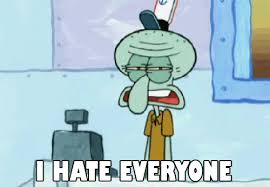

You before reading this book:
You after reading this book:

Sunday, February 2, 2014
Real Life Issues (Infinite Crisis)
One of the real life issues that is apparent in Infinite Crisis is one that happens inside of us. The issue is that whenever we do something that is preposterous, antagonizing, or embarrassing, we as humans have a tendency to dwell in the past. For example, maybe you released feelings of anger in public and then you regret the decision thinking something like "No, I didn't mean to do that! I'm not a bad person! I wish I could go back and change what happened!"
In events prior to Infinite Crisis, Wonder Woman had to kill a man because he was controlling Superman's mind. The man was manipulating Superman into becoming a killer. Wonder Woman regretted the time that she had to kill him. It would always bother her and haunt her in days to come. Later in the story, however, Wonder Woman learns that you must not focus on what has already happened, but what lies ahead. Greg Cox, the author of this book, is saying that you should not dwell in the past.
In events prior to Infinite Crisis, Wonder Woman had to kill a man because he was controlling Superman's mind. The man was manipulating Superman into becoming a killer. Wonder Woman regretted the time that she had to kill him. It would always bother her and haunt her in days to come. Later in the story, however, Wonder Woman learns that you must not focus on what has already happened, but what lies ahead. Greg Cox, the author of this book, is saying that you should not dwell in the past.
Sunday, January 26, 2014
The Best Thing About My Book (Infinite Crisis)
Reading a book such as Infinite Crisis is great because of the fact that not only it has a good story and shows some of my favorite heroes. It also is a great read for wild and extreme action sequences. You'll have superheroes brawling with giant figures and causing mass chaos in the area. Also, the action sequences aren't like the ones that you saw on TV as a kid. They won't be afraid to show bloodshed, body parts, and even death. The fight scenes are well thought out and not just superheroes and villains throwing punches all over the place. There's great schemes and strategies. You never know when a massive battle will just jump right out at you. It won't do it literally of course. If a book did that, then the author would be covered in lawsuits. Anyway, you get the point. This book has amazing and spectacular combat. What about your book? What's the best thing about it?
Wednesday, January 8, 2014
A Symbol for a Character (Infinite Crisis)
For the character known as Brother Eye in my book, a good symbol for it would be a hawk. Brother Eye is a machine programmed by Batman to see where there is trouble and send OMAC soldiers to deal with the criminal. However, Brother Eye is ruthless. It would kill innocent people in order to get to the actual criminal. Also, Wonder Woman had to kill someone in order to free Superman from hypnosis which made him a killer. Because of Wonder Woman killing that man, the OMACs attacked the whole island of Themyscira. Brother Eye is like a hawk because he watches the Earth closely for criminals. A hawk watches the ground closely for its prey. And both Brother Eye and the hawk are ruthless to the criminals/prey.


Thursday, January 2, 2014
The Worst Thing About My Book (Infinite Crisis)
My book, Infinite Crisis, is an interesting book. But one thing about it makes me confused as to why the author included this in his book. My book will always switch topics and settings and it seems all over the place and a bit messy. One minute, the story might be in Atlantis talking about Spectre attacking it, while the next moment it goes to a completely unrelated moment in Themyscira where they have to defend it from the OMACs. To those not reading the book, it sounds a bit crazy. It's as if they put multiple stories into one book. I know that in the end it will probably connect it all together, but now, it just seems all over the place. I would like it to explain what's going on and why they are jumping from place to place so often. The book isn't bad. However, I would not prefer the randomness.
Subscribe to:
Posts (Atom)