Wednesday, April 13, 2016

On Dumpster Diving Blog

Joseph Cooper
Mrs. Parkinson
English IIIB
13 April 2016
Pathos of Dumpster Diving
     The poor: a group commonly painted as disorganized slobs by the popular media. But are they really all that different from you and me? As discussed by Lars Eighner, there is satisfaction, but also sorrow. What is considered useless to one man, is priceless to another.
     The things found in dumpsters may not always carry value. Some things, according to Eighner, are harmful to people like him. He explains, "I have heard of people maliciously contaminating discarded food." Imagine that half of your food supply was contaminated. How would you feel? This is the hardship that people such as Eighner have to endure every day. Would you want that for yourself? What about your family?
     Everyone is human, regardless of income. If we don't learn to respect each other, it only tears us apart. Examples such as these evoke the strongest emotion. We've all encountered someone who has tried to make our lives worse. Maybe it's a student. Maybe it's a coworker. Maybe it's your own family. Our country needs not more enemies, but more friends.


Monday, March 14, 2016

Chapters 2, 3, 4 Inquiry Activity

Joseph Cooper
Mrs. Parkinson
English IIIB
15 March 2016
The Effects of Dreaming on Survival
            What defines survival? Is it simply the ability to exist? Is it the ability to experience a satisfying, fulfilling existence?
In George and Lennie’s case during Of Mice and Men, it is. They aspire to escape a brutal life of continuous moving and searching. It’s because of this that they’ve advanced this far. Such dreams comfort Lennie when George tells him about how “We’d jus’ live there. We’d belong there. There wouldn’t be no more runnin’.” Without dreams such as these, there’s no reason to persist, or even to live.

It was 8th grade—the first time that I watched the Mason High School Wind Symphony—that inspired me to persist. When I first saw them perform, I knew that I wanted to play in that band. After grueling hours of practice, and one classmate calling me crazy, such a dream became a reality. This has truly defined my survival.

Monday, March 7, 2016

Long Live the Renaissance

Over 200 years, America has lived. 200 years, and not everybody has learned how to overcome prejudice and hatred. Like the years preceding, the 20’s supported these practices. Many encouraged racism. Cullen contested the idea. The voice of his poetry transcends the plague of racism. It’s a plague that manifests itself even in our country today.
When someone mentions the terms, Ferguson and Baltimore, does that sound familiar? It should. Both cities were the settings of riots resulting from someone’s death. Some blamed the police. Some blamed the criminals. Whatever the opinion, it’s impossible to deny the existence of racism.
When we listen to Cullen’s Tableau, we can learn from “the black boy and the white” who are “locked arm in arm”. They prove that racism is learned, not innate. Race only becomes an issue if we make it that way. The most important issue is, “How can we improve?”

Friday, November 20, 2015

George Saunders, “On the Importance of Kindness”

Ellen: a young girl in search of someplace to call "home". She endured a painful struggle just to fit in with the crowd. She was judged not by her character, but by the way she dressed. To offer us an example, Saunders tells us that she wore "these blue cats eye glasses that at the time only old ladies wore." In relation to the time period, those glasses were out of style. The audience understands that during this time, young girls who wore these glasses would experience teasing and bullying from the author's insight on this topic. Today's readers (especially those under 18) would likely not have any knowledge regarding fashion during the era of Ellen's childhood, nor would they have any idea how Ellen felt.

Not everybody knows the horror of being bullied, ostracized, demeaned. Not everybody has even seen this occur. Ellen would walk through the halls, "eyes cast down, a little gut-kicked." The imagery of this statement condemns the act of tormenting others. What looks like a joke to you, is a life of pain for them. Being able to see the scene, to feel Ellen's pain, offers a whole new perspective on the sheer magnitude of the story. Why must she be the one to go through such injustice? What prompted those bullies to do such unspeakable things to Ellen? As a society, there's one thing (among many) that we continue to do and never learn from. We resent the unfamiliar. During the Cold War, people hated communists. During the Iraq war and even today, people hated Muslims. And now, in Saunders' experience, people hated Ellen. Why? Because she was different.

Saunders tried to help, but his assistance was overshadowed by the malicious intent of the other students. It is Ellen's suffering that causes Saunders to remember her so fondly. Despite the fact that Saunders is telling the story, he connects it to everybody. He asks the audience, "Or, to look at it from the other end of the telescope, who in your life, do you remember most fondly?" This question proves interesting to the audience, showing that everyone has at one time been in Saunders' shoes. Everyone in this room, everyone who is reading this post right now, knows someone special in their life. My dad, the one who raised me from when I was an infant in New Hampshire to now, and he's still going. Every struggle and accomplishment that I've had, he's been there. With my sister away at college, he's all I have to talk to. Who in your life makes all the difference regardless of where you are?

Sunday, November 15, 2015

Catcher in the Rye 17-18

"That's not how you write a W!" the teacher screamed before I frantically erased my handiwork. It was my first grade teacher, we'll just call her Mrs. Doe, that made writing the alphabet feel like defusing a bomb. The slow, steady movement of my pencil marked my survival, or my failure. Mrs. Doe walked across the room like a warden inspecting the prisoners.

I'm free from those people when I'm in my basement. Nobody talks about my mistakes or every single flaw about me. I live on my own terms, carefree. When I go down there, my drum set calls out to me, to beat rhythm after rhythm. Nobody is there to judge or patronize. It' just me, and only me.

Catcher in the Rye 15-16

Ding! The bell sounds as the students at Mason Intermediate rush away from the lunch room, making sure to put their trays away. One by one, they toss the trays onto the stack, no sense of order or cleanliness. After seeing the monstrous creation of the students, a loud voice in my mind screams at me to put things in order. Every day, this would be the pattern. I didn't care if anyone knew it was me. I didn't even care that I was doing a good thing. The fact that the others were being so disorganized just irritated me. If I didn't straighten them, who would?

Tuesday, November 10, 2015

Catcher in the Rye 9-10

    Disguised as a simple annoyance, an idea manifests itself inside of every living man, woman, and child. The rattle that happens in your car, the one that nobody else can hear. Screeching inside your mind lies a voice that can't be silenced, but at the same time can't be heard. The question is this: Why can't anybody hear the rattle? Why can't anybody stop the rattle and guide me to silence? Nobody ever will. The rattle is yours and yours only. Each individual faces a problem that only they can
perceive, ignorant of all others.

    Holden's rattle sings of his late brother, Allie. After pouring out a heartfelt essay about Allie's baseball glove, Stradlater dismisses Holden by saying, "For Chrissake, Holden. This is about a ****** baseball glove." Stradlater, while holding on to his own rattle, failed to hear Holden's. In a similar fashion, the dealership worker, after being unable to hear the rattle in Daryn's car, gives her the "It’s time for you to go home now, Crazy Lady" look. The rattle didn't appear, but it was still there.

    The most sensitive memories, the most painful, appear only to us. The rattle inside our brains every second of every day. Rattle, rattle, rattle, you hear faintly. To lower the volume is simple. To erase it completely is impossible.
      

Saturday, August 9, 2014

Summer Reading Blog Post 4

The reason I chose this book, In Darkness, was because it seemed different from most other books. I didn't want to read a book about a sappy love story or some fantasy book that recycles elements from pretty much every other fantasy novel. This book was definitely worth my time. When I was reading this book, it had some brutal things that happen in real life. It had shootings, war, poverty, and desolation. It felt like the author knew that I could handle swearing and violence instead of trying to hide me from it. Even though it has all this, it still is poetic, and meaningful.

I would recommend this book to people who like action and are tired of the same old love story or fantasy novel. Someone who doesn't mind a little profanity but still would yearn for interesting things to happen. You may also like this book if you are interested in history. It tells about the revolutionary from Haiti, Toussaint l'Ouverture. It shows how he rebels against the whites to free the slaves of Haiti. It shows how he is connected to a modern day boy named Shorty and they both experience the lives of one another. If you're interested in an exciting, poetic, and historic novel, you would love to read this book.

Summer Reading Blog Post 3

One of the passages from the book that hooks the reader is, "I am the voice in the dark, calling out for your help. I am the quiet voice that you hope will not turn to silence, the voice you want to keep hearing cos it means someone is still alive. I am the voice calling for you to come and dig me out. I am the voice in the dark, asking you to unbury me, to bring me from the grave and out into the light, like a zombi."

During this part of the book, the main character whose name is later revealed to be Shorty, has been trapped in the darkness when a building collapsed under an earthquake. It shows that he still has hope that somebody might come rescue him from is dark, desolate prison. The author uses repetition in this paragraph to hook the reader and create a rhythm. The writing has a poetic feeling to it. It also provides a sense of wonder. What's going on? What happened to this person? Is he/she dead? The odd thing is, the character doesn't exactly know either. All that he knows is that he probably will stay trapped under the rubble in the darkness for the rest of his life, maybe even eternity.


Monday, July 7, 2014

Summer Reading Blog Post 2

One main character in my book is a child that gets trapped under building rubble after an earthquake. He doesn't tell us his name. His main goal throughout the story is to survive the wreckage. He constantly yearns for water and does lots of crazy things in order to survive. For example, he gets so thirsty that he drinks his own urine for sustenance. He doesn't know whether he is still alive or not. It's impossible to be sure of anything in the darkness in which he is trapped.

Another main character is Toussaint l'Ouverture. His desire is for the rebellion to succeed against the white slavers that rule his nation. He is tasked with leading the rebellion because he is chosen by an Iwa (vodou god). He also feels conflicted as to whether he believes in the vodou or the Christian religion.

Some themes that are beginning to appear is that the risk of death can make people do crazy things. For example, as mentioned before, the child drinks his own urine. Another theme is that people can do great things if they are passionate. Toussaint l'Ouverture wasn't very into the vodou religion. Some people also said that he was visually unappealing. However, he is passionate about leading the rebellion.

In this story, it doesn't say chapter numbers. It says THEN or NOW. THEN focuses on the story behind Toussaint l'Ouverture. NOW focuses on the child's story.


Saturday, July 5, 2014

Summer Reading Blog Post 1

My book, In Darkness by Nick Lake, has two different story lines. One is about a 15 year old Haitian child. He doesn't really reveal his name. All that we know about him is that he is trapped under a collapsed building after an earthquake. He doesn't really know whether he may be dead or alive. He constantly struggles to find water and food. He tells us all about how it led to him being trapped. This seems similar to the time that a man got his arm stuck in a mountain when he went rock climbing. He eventually had to cut his arm off to free himself. This is similar because both people were trapped with almost no sustenance and nobody was able to help him. However, the rock climber had light. I predict that the child will die in the rubble. I think that people  think that no one else is there.

 The other story in the book focuses on Haitian revolutionary, Toussaint l'Ouverture. He is a slave that believes in both the vodou and Christian religion. He has to lead a rebellion against the white slavers that occupy the country. He finds out during a ceremony before the war that he was chosen by an Iwa (vodou god) to lead the rebellion. This is similar to the Warsaw Ghetto Uprising in Germany because the Jews in the ghetto rebelled against the Nazis that tried to take them to a concentration camp. I predict that the rebellion will triumph.

How will the story connect Toussaint to the child? What will happen to both of the protagonists?

Tuesday, February 18, 2014

Final Blogger Assessment - English 1B

This is my blog with the best voice.
http://cooperjosephblog.blogspot.com/2014/01/the-best-part-about-my-book-infinite.html#comment-form


One example of a sentence that demonstrates my writer’s voice is when I say “It won't do it literally of course. If a book did that, then the author would be covered in lawsuits”. This sentence talks about how earlier I said “…a massive battle will just jump right out at you”. This demonstrates my voice because I include some humor which can help you hear my voice more easily. Another phrase that demonstrates my writer’s voice is “…shows some of my favorite heroes”. This demonstrates my voice because I’m talking about my favorite heroes and you can hear my voice.


In my blog post, I have purposefully included informal diction. One example of informal diction is “Also, the action sequences aren't like the ones that you saw on TV as a kid”. This is informal diction because it talks directly to you so it feels like a normal conversation. I included this in order to better connect with the reader. A syntax technique that I include in my blog post is that I ask questions. An example of one that I ask is, “What about your book?” I include this in my post so that I can talk to the reader and make him/her able to interact with me.
 

Sunday, February 9, 2014

Advertisement (Infinite Crisis)

Superheroes: they work countless hours to save the day from those evil super villains who threaten the lives of humanity. They have always defeated super villains. Their missions have always been moderately easy - until now. Hordes of threatening villains now endanger the lives of the population, the heroes, and even Earth itself. Blood will be shed. Lives will be taken. Reality itself lies in the hands of the superheroes. Will the universe be saved? Will it collapse and die? What evil maniac would do such a thing and why? Read Infinite Crisis and find out.


                                                             You before reading this book:


You after reading this book:


Sunday, February 2, 2014

Real Life Issues (Infinite Crisis)

One of the real life issues that is apparent in Infinite Crisis is one that happens inside of us. The issue is that whenever we do something that is preposterous, antagonizing, or embarrassing, we as humans have a tendency to dwell in the past. For example, maybe you released feelings of anger in public and then you regret the decision thinking something like "No, I didn't mean to do that! I'm not a bad person! I wish I could go back and change what happened!"

In events prior to Infinite Crisis, Wonder Woman had to kill a man because he was controlling Superman's mind. The man was manipulating Superman into becoming a killer. Wonder Woman regretted the time that she had to kill him. It would always bother her and haunt her in days to come. Later in the story, however, Wonder Woman learns that you must not focus on what has already happened, but what lies ahead. Greg Cox, the author of this book, is saying that you should not dwell in the past.

Sunday, January 26, 2014

The Best Thing About My Book (Infinite Crisis)

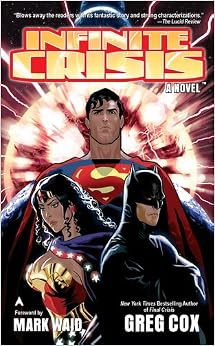
Reading a book such as Infinite Crisis is great because of the fact that not only it has a good story and shows some of my favorite heroes.  It also is a great read for wild and extreme action sequences. You'll have superheroes brawling with giant figures and causing mass chaos in the area. Also, the action sequences aren't like the ones that you saw on TV as a kid. They won't be afraid to show bloodshed, body parts, and even death. The fight scenes are well thought out and not just superheroes and villains throwing punches all over the place. There's great schemes and strategies. You never know when a massive battle will just jump right out at you. It won't do it literally of course. If a book did that, then the author would be covered in lawsuits. Anyway, you get the point. This book has amazing and spectacular combat. What about your book? What's the best thing about it?

Wednesday, January 8, 2014

A Symbol for a Character (Infinite Crisis)

For the character known as Brother Eye in my book, a good symbol for it would be a hawk. Brother Eye is a machine programmed by Batman to see where there is trouble and send OMAC soldiers to deal with the criminal. However, Brother Eye is ruthless. It would kill innocent people in order to get to the actual criminal. Also, Wonder Woman had to kill someone in order to free Superman from hypnosis which made him a killer. Because of Wonder Woman killing that man, the OMACs attacked the whole island of Themyscira. Brother Eye is like a hawk because he watches the Earth closely for criminals. A hawk watches the ground closely for its prey. And both Brother Eye and the hawk are ruthless to the criminals/prey.

Thursday, January 2, 2014

The Worst Thing About My Book (Infinite Crisis)

My book, Infinite Crisis, is an interesting book. But one thing about it makes me confused as to why the author included this in his book. My book will always switch topics and settings and it seems all over the place and a bit messy. One minute, the story might be in Atlantis talking about Spectre attacking it, while the next moment it goes to a completely unrelated moment in Themyscira where they have to defend it from the OMACs. To those not reading the book, it sounds a bit crazy. It's as if they put multiple stories into one book. I know that in the end it will probably connect it all together, but now, it just seems all over the place. I would like it to explain what's going on and why they are jumping from place to place so often. The book isn't bad. However, I would not prefer the randomness.

Monday, December 9, 2013

Connections (Infinite Crisis)

One thing that be connected in the real world is the security robots. These security robots are used to enforce the law and bring criminals to justice. However, these robots end up using extreme tactics in order to achieve their mission. When finding a criminal, they were searching in an alley. They asked an old man where he was keeping a criminal and the robots beat him. The eventually found the villian and killed him. This can be connected to our world because the government can get paranoid. They can take extreme measures in order to keep security. They put security cameras in houses, they can harm innocent protestors, and they can arrest you for the slightest hint that you may be a criminal.

Sunday, December 8, 2013

Reason for Reading (Infinite Crisis)

My independent reading book for this trimester is Infinite Crisis by Greg Cox. I chose this book because it is about the Justice League. It is a 371 page read with great vocabulary that you can find in the story. This book is full of action and some of the best superheroes around. In the book, the Justice League has lost some of its trust from the people on Earth. Wonder Woman had to snap someone's neck because he had control over Superman. This seems like a very interesting plot and something definitely unlike any other superhero movie or comic that I have seen before. I want to see how the book plays out and how this situation is finally resolved. What about a book makes you interested in reading it?

Wednesday, December 4, 2013

Fahrenheit 451 (Predictions)


In my book, I predict that Guy Montag will try to rebel against the dystopian government that rules over the society that he lives in. The books that he is keeping secret will inspire him to rebel against the government. Judging by the absolute control over the society, they probably have every other citizen convinced that the government is fine how it is. Because of this, Guy lacks support from the other people. Which leads to my prediction that Guy will die in the attempt to overthrow the government. I also believe that Mildred will play a role in Guy's demise. She doesn't show any love or deep feelings for Guy. Also, she is skeptical and a bit scared of the idea of Guy reading. This might cause her to break down and give Guy away to the government. The society will remain unchanged for a long period of time. What about you? What do you think will happen to Guy and the society that he lives in?